Belmont
Public Schools

Click image to visit specific page.
This portal has been created to keep the Belmont community updated about the Belmont School Committee's (BSC) ongoing collective bargaining negotiations with the Belmont Education Association (BEA) for a 2025-2028 successor contract. We will continue to provide updates on this site regularly, as well as via posts on our social media accounts (Facebook: BelmontPublicSchools, and X: @belmontschools). We encourage you to visit these resources often for the latest updates.
May 29, 2026
Dear Belmont Public Schools Community,
We are pleased to share that the Belmont School Committee (BSC) voted to approve the ratified contracts with the Belmont Education Association (BEA) this past week.
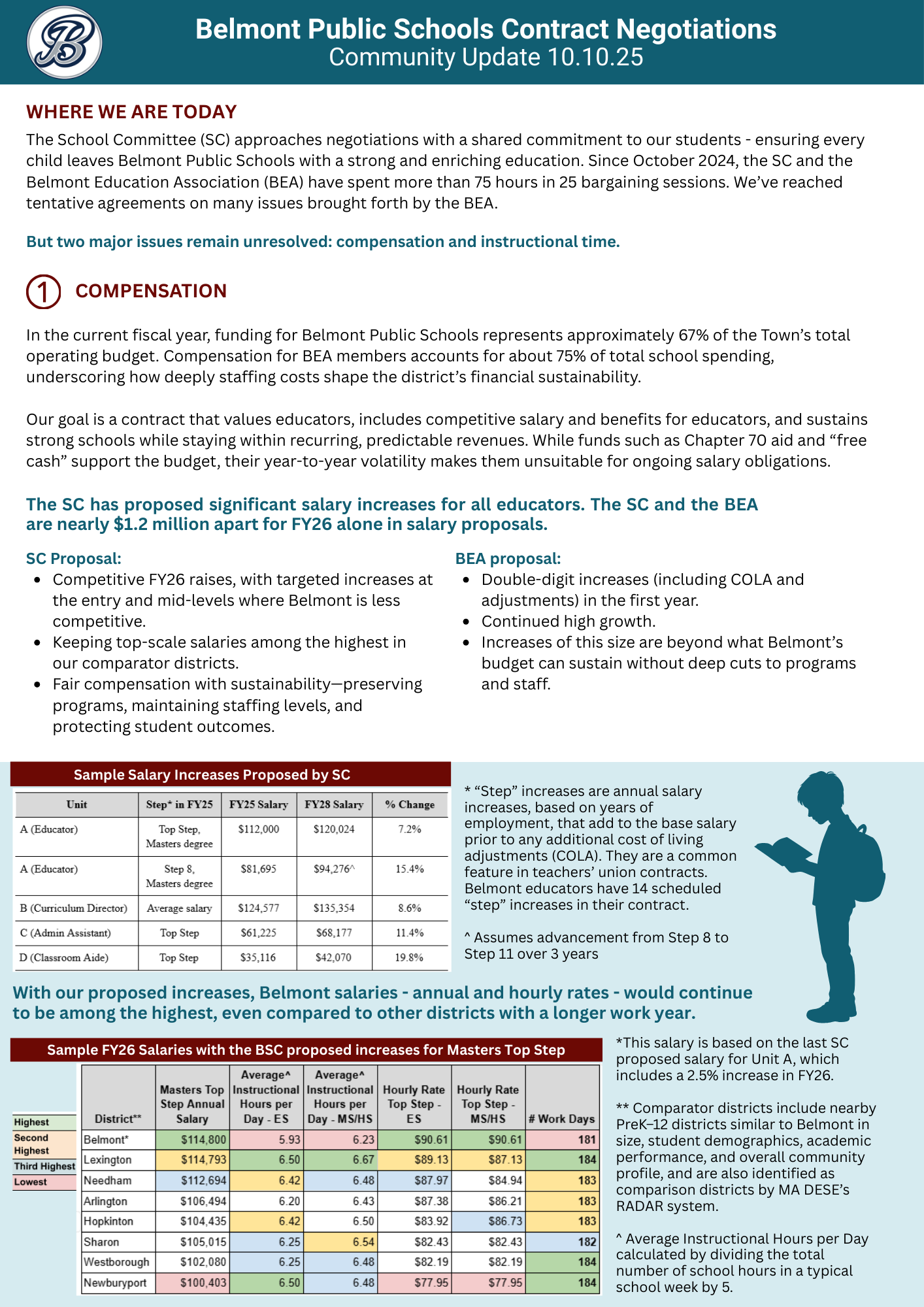
These settlements represent important investments in Belmont educators, staff, students, and families. They are the result of more than 19 months of negotiations, collaboration, compromise, and mediation focused on reaching fair and competitive agreements that support our educators and students while remaining financially sustainable.
The negotiations began in October 2024 with more than 230 proposals from the BEA and more than 80 proposals from the BSC. Through many months of discussions and exchanges of proposals, the parties ultimately reached agreement on 128 contractual changes. While some of these changes involve clarifications or updates to contract language, many represent significant enhancements, including:
Salary increases for all units and ratification bonuses
Paid parental leave
Expanded access to sick leave banks
Increased longevity payments and stipends
Additional time for collaboration and preparation for both teachers and professional aides
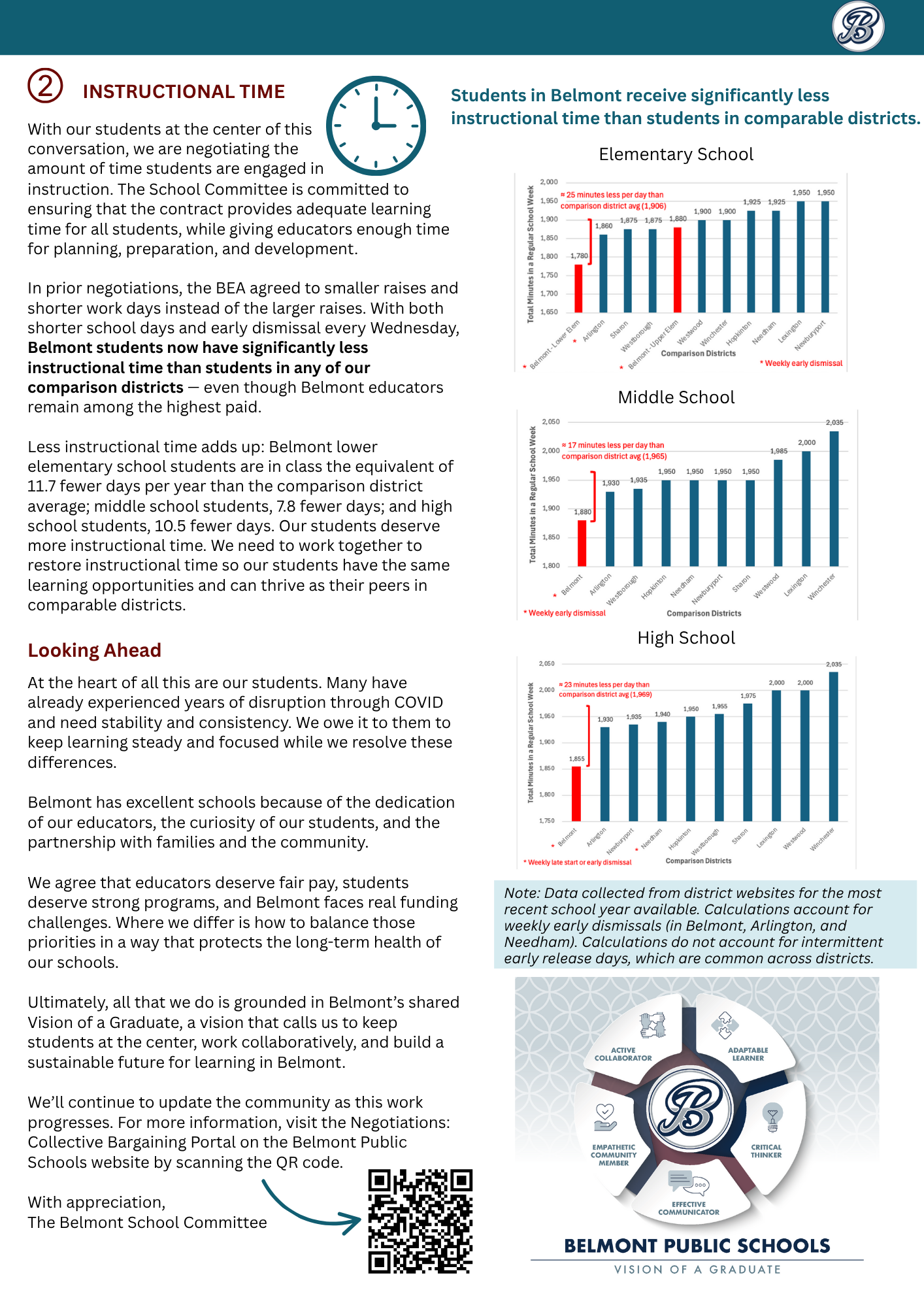
One particularly important outcome of these agreements, and one of BSC’s priorities from the start, is an expanded school day. Beginning in the 2026–2027 school year, students will benefit from an additional 15 minutes of instructional time each day, an important gain that will provide greater opportunities to engage with the curriculum, strengthen grade-level skills, and continue academic growth. It will also support teachers’ instruction as they implement increasingly rigorous learning experiences, including recently adopted literacy and mathematics curricula at the elementary and upper elementary levels. Importantly, this additional instructional time will benefit students across all grade levels.
The agreements also include the creation of a new job classification within Unit D (Paraprofessionals, Classroom Aides, Building Substitutes, and Campus Monitors) for behavioral support staff. Working closely with classroom and special education teachers, these behavioral support specialists will help students develop self-regulation skills, increase engagement in learning, and thrive in the school environment. Through the FY27 budget, funding has been included for 10 of these positions beginning next year.
Another meaningful outcome of the negotiations is the establishment of several joint working groups. These groups will focus on topics such as professional development scheduling, parent-teacher conference structures, class size and caseload considerations, and elementary teacher preparation time, topics that were too complex to fully resolve during negotiations. By creating dedicated spaces for collaborative problem-solving, the BEA and the BSC/District have affirmed a shared commitment to addressing challenges thoughtfully and constructively.
The agreements reached through this process reflect our deep appreciation for our Belmont educators and staff and our commitment to supporting the success of our students. We believe these agreements also show the balance we have worked toward throughout negotiations: supporting and investing in our educators, expanding opportunities for students, and ensuring that Belmont can continue to sustain these investments in the years ahead. While we are proud of what was accomplished through these agreements, strengthening our schools is an ongoing effort, and there is always more work ahead. To learn more about the agreements, including a complete list of contractual changes, please visit our website.

Meg Moriarty, Ed.D., BSC Chair

Jill Geiser, Ed.D., Superintendent
** STUDENTS * EDUCATORS * LEADERSHIP * EFFECTIVE PRACTICES * TIME * CLARITY **